
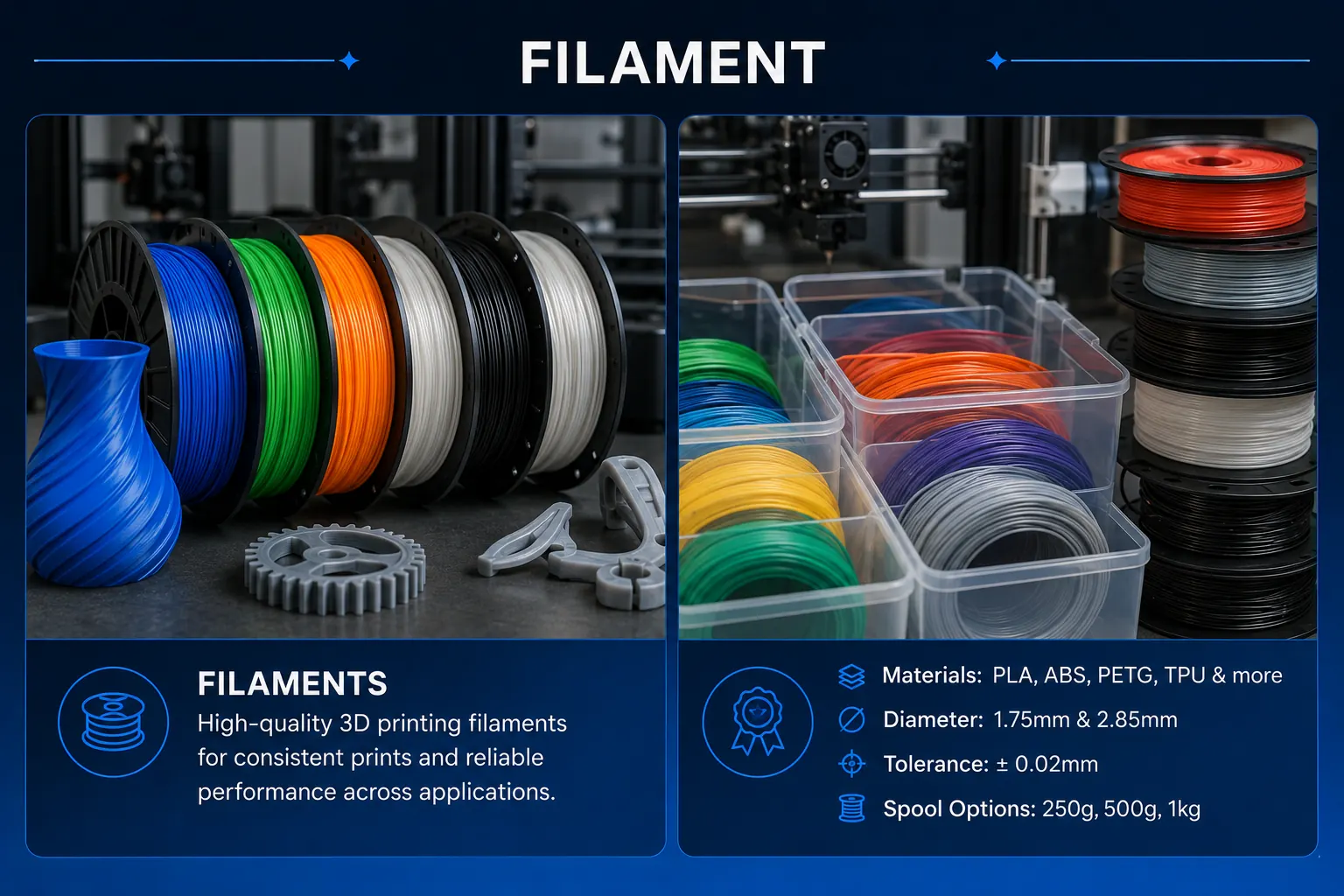
The right 3D printing material depends on what the part needs to do, not simply on the material name. Before choosing a filament or resin, consider load, temperature, flexibility, appearance, environment and finishing requirements.
Start with the application
Ask whether the part is a visual model, a fit-check prototype, a functional component, a fixture or a final-use part. This immediately narrows the material choices.
Common filament considerations
- PLA: Easy to print and useful for visual prototypes, mock-ups and general-purpose parts.
- ABS: Useful where higher temperature resistance and toughness are needed, with more demanding printing requirements.
- PETG: A practical option when you want a balance of ease of printing, toughness and chemical resistance.
- Nylon: Useful for durable engineering parts where toughness and wear resistance matter.
What about resin?
Resin selection becomes important for SLA. Standard resin can suit detailed models, while tough, flexible or castable resins address more specific requirements.
Five questions to ask
- How much mechanical load will the part see?
- Will it be exposed to heat or chemicals?
- Does it need to flex?
- How important are surface finish and small features?
- Will the part be used once or repeatedly?
For a project with uncertain material requirements, send the application and expected operating conditions along with your CAD file. HyCube Works can help match the process and material to the job.
Have a part to manufacture?
Share your CAD file, quantity and requirements with HyCube Works for 3D printing, fabrication or digital manufacturing support.
Get a Quote →